Key takeaways
- Go step by step, pairing each new piece of equipment with treats.
- Stay below your dog's stress threshold — if your dog pulls away, go back a step.
- A crate should be a safe, comfortable den, never a punishment.
- Muzzle training is a smart skill for every dog — for vet visits, emergencies and grooming.
Many dogs are uncomfortable with new equipment at first. Taking a little time to introduce it positively prevents years of struggle. The basic recipe for everything below is the same: show it → treat; touch → treat; wear briefly → treat; gradually longer.
Collar
- Let your puppy sniff the collar. Treat.
- Put it on for a few seconds during a meal or play. Take it off.
- Gradually increase the time.
- Check the fit: you should be able to slide two fingers between the collar and neck.
Some puppies scratch at a collar at first; distract with play and it usually stops within a day or two.
Harness
Harnesses that go over the head can be scary. Try this:
- Hold the head loop open and put a treat on the other side, so your dog puts its head through to get it.
- Repeat, gradually holding the loop longer.
- Buckle for a second, treat, unbuckle.
- Build up wearing time indoors before going out.
See harness vs collar for choosing the right type.
Leash
- Clip the leash on indoors and let your puppy drag it (supervised) while you play.
- Pick it up and follow your puppy around.
- Call your puppy toward you a few steps and reward at your side.
- Move to short walks in quiet places.
For loose-leash walking, see stop leash pulling.
Avoid retractable leashes during training. They teach dogs that pulling extends the leash, and the thin cord can cause burns and cuts.
Crate training
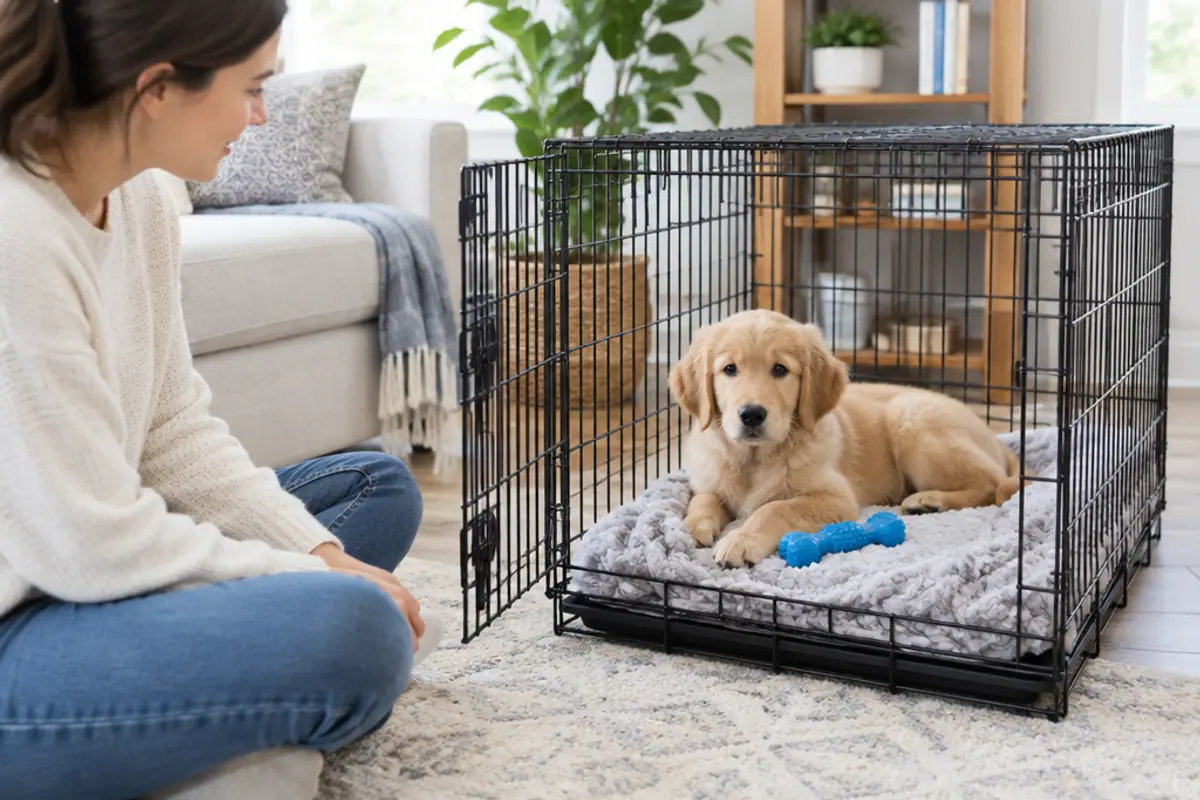
A crate gives your dog a safe den, helps with potty training and keeps your dog safe when you can't supervise. It's also invaluable for travel and vet stays.
Choosing a crate
Big enough to stand, turn around and lie stretched out — but not so big that a puppy can potty in one end. Use a divider for growing puppies.
Step by step
- Put the crate in a family area. Add a soft bed and leave the door open.
- Toss treats inside. Let your dog go in and out freely.
- Feed meals inside the crate, with the door open.
- Once your dog goes in happily, close the door briefly during a meal. Open before it finishes.
- Give a long-lasting chew or stuffed food toy in the crate and close the door for a few minutes while you sit nearby.
- Gradually increase time and move out of sight for short periods.
Crate rules
- Never use the crate as punishment.
- Don't crate for too long. Puppies can only hold their bladder for a limited time; adults shouldn't be crated for most of the day. A rough guideline for maximum daytime crate time for adults is 4–5 hours, with plenty of exercise and attention before and after.
- Remove collars in the crate (they can catch).
- If your dog panics in the crate — injuring itself, escaping, drooling heavily — stop and talk to your vet or a behavior professional.
Carrier (for small dogs and travel)
Follow the same steps as crate training. Leave the carrier out as a bed, feed treats inside, then practice lifting it briefly, walking around the house and short car rides. See traveling with a dog.
Muzzle training
Every dog can benefit from muzzle training — for emergencies, vet visits, grooming or travel rules. A well-fitted basket muzzle lets your dog pant, drink and take treats. Avoid tight "grooming" muzzles for anything more than a few minutes.
- Show the muzzle → treat.
- Hold the muzzle so your dog pushes its nose in to get a treat placed inside (a squeeze of dog-safe spread works well).
- Gradually wait longer before giving the treat.
- Briefly fasten the strap → treat → unfasten.
- Build wearing time slowly, pairing with walks and fun activities.
Take several days to weeks. The goal is a dog that happily sticks its face into the muzzle.