Key takeaways
- Your dog should be able to stand, turn around and lie down comfortably.
- Wire crates are great at home; plastic crates are standard for air cargo; soft carriers suit small dogs in cabins.
- For car safety, look for independently crash-tested crates and carriers.
- Always check airline dimensions before buying a travel carrier.
A crate or carrier gives your dog a safe den at home and a secure way to travel. Choosing the right type and size makes crate training much easier.
Types of crates
| Type | Pros | Cons | Best for |
|---|---|---|---|
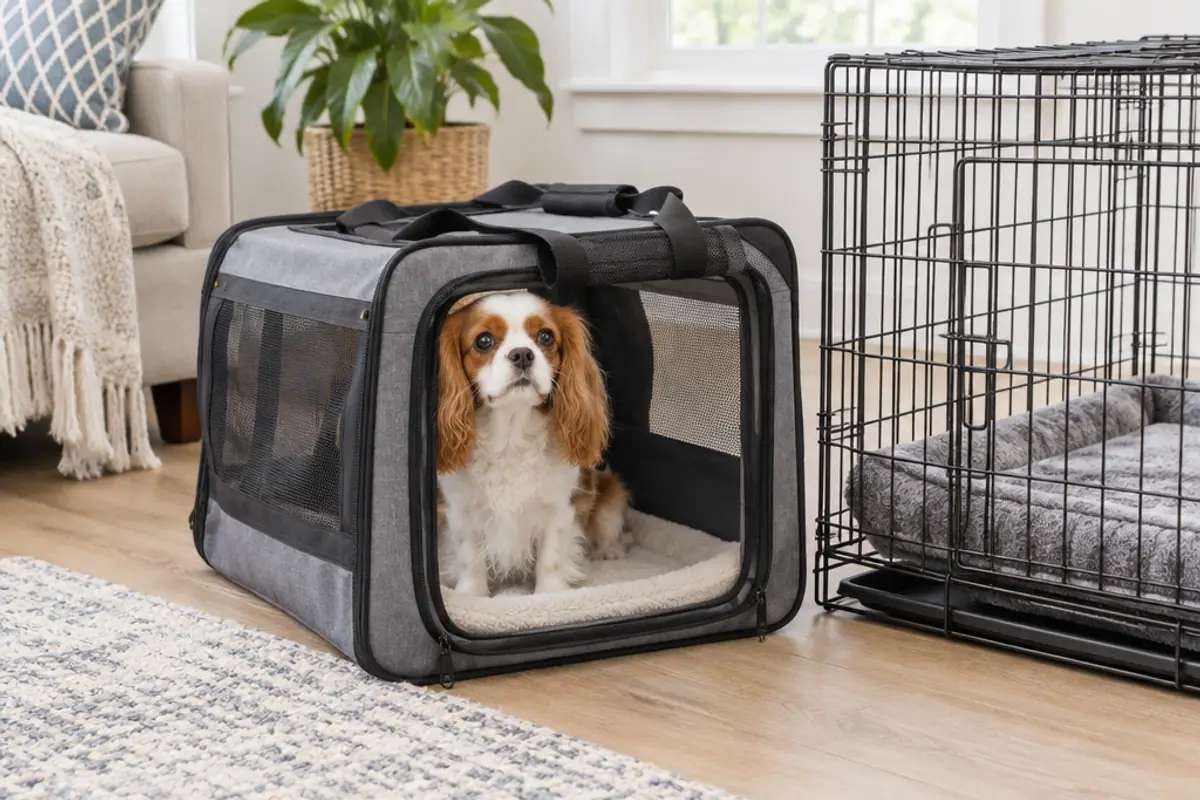
| Wire crate | Good airflow and visibility, foldable, often includes a divider | Noisy, less den-like (use a cover), not for escape artists | Home use, puppies |
| Plastic crate | Den-like, durable, easy to clean | Less airflow, bulkier | Air cargo travel, dogs who like privacy |
| Soft-sided crate | Lightweight, portable | Easy to chew or escape from | Calm, crate-trained dogs, travel |
| Heavy-duty crate | Very strong | Expensive, heavy | Escape artists (consult a professional — escape attempts may signal panic) |
| Furniture-style crate | Looks like an end table | Expensive, less airflow | Calm adult dogs in living spaces |
Choosing the right size
Your dog should be able to stand up without ducking, turn around, and lie on its side with legs stretched out.
- Measure your dog's length from nose to base of tail and add 2–4 inches (5–10 cm).
- Measure height from the floor to the top of the head (or ear tips if they stand up) while sitting, and add 2–4 inches.
For puppies, buy a crate for their expected adult size and use a divider panel to adjust the space as they grow. Too much space may encourage potty accidents in one end.
Travel carriers
Soft-sided carriers (in-cabin)
- Must fit under the airplane seat — check your airline's maximum dimensions, as they vary.
- Look for ventilation on several sides, a secure zipper, a padded shoulder strap and a waterproof bottom.
- Your dog should be able to stand and turn around.
Hard carriers (air cargo)
Airlines typically require crates that meet IATA Live Animals Regulations: rigid construction, metal door, secure fasteners, ventilation on multiple sides, and a leak-proof floor. Check with your airline before buying.
Car travel
For car safety, look for crates, carriers or harnesses that have been independently crash-tested (for example, by the Center for Pet Safety in the U.S.). Secure crates in the cargo area, and carriers with a seat belt. See traveling with a dog.
Playpens and gates
- Exercise pens give puppies a larger safe area than a crate — great for when you're home but busy.
- Baby gates limit access to rooms and stairs.
What to put inside
- A washable crate mat or bed (skip it for chewers until they're past that stage)
- A safe chew toy or stuffed food toy
- Water for longer periods (a crate-mounted bowl prevents spills)
- A breathable cover to make it den-like
Remove collars inside crates to avoid snagging, and never leave items your dog could chew up and swallow.